Chongqing Zhonggu Blower Co., Ltd. welcomes you!


Product Showcase
PRODUCTS
Product

Chemical Industry Fan: Fluidized Bed Blower
The motor power required for a chemical‑process fan refers to the power needed under specific operating conditions; when the inlet damper is fully open, the power demand is at its maximum. Operating with the inlet damper fully open may damage the motor. During commissioning, it is advisable to close the valves on the fan’s inlet or outlet piping, then gradually open them once the fan is running until the desired operating conditions are achieved, while monitoring that the fan’s operating current does not exceed its rated value.

Anti-corrosion Fan: GDF Duct Fan for Exhaust Applications
The main components of corrosion‑resistant fans are either treated with anti‑corrosion coatings or manufactured from corrosion‑resistant materials, and such fans are collectively referred to as corrosion‑resistant fans. These fans are widely used for ventilation, dust removal, and odor extraction in factories, mines, electroplating facilities, chemical plants, etching operations, and other similar environments.
Chongqing Blower: GDF Duct Fan for Exhaust Applications
The Chongqing blower consists primarily of the following six components: the motor, the air filter, the blower body, the air chamber, the base (which also serves as the oil reservoir), and the oil drip nozzle. The blower operates by means of an eccentrically mounted rotor within the cylinder; as the rotor turns, the changing volume between the blades in the rotor slots draws in air, compresses it, and then discharges it.
General-purpose fan: GDF duct fan for corridor applications
Precautions for General-Purpose Fans The grounding of the fan housing or motor housing must be reliable. Do not operate in the reverse direction; do not run at currents exceeding the rated value; do not operate with a missing phase. Do not perform maintenance on the fan while it is running.
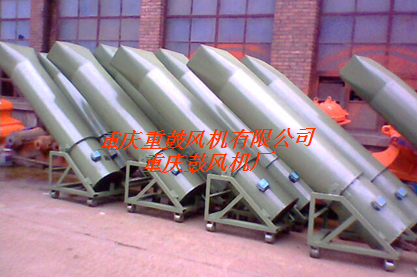
Chongqing Fan: Duct-mounted GDF centrifugal fan
The normal bearing temperature for a Chongqing fan is ≤70°C. If the temperature rises to 70°C, an electric control system should trigger an alarm. At this point, the cause must be investigated: first, verify that the cooling water flow is normal and that the bearing oil level is adequate. If the root cause cannot be identified promptly and the bearing temperature rapidly climbs to 90°C, the electric control system should issue another alarm and initiate a shutdown signal.

The blower consists primarily of the following six components: the motor, the air filter, the blower body, the air chamber, the base (which also serves as the oil reservoir), and the oil‑drip nozzle. The blower operates by means of an eccentrically mounted rotor within the cylinder; as the rotor turns, the volume between the blades in the rotor slots expands and contracts, drawing in air, compressing it, and discharging it. During operation, the pressure differential generated by the blower automatically delivers lubricant to the oil‑drip nozzle, which drips into the cylinder to reduce friction and noise while preventing backflow of gases inside the cylinder. Blowers of this type are also known as sliding‑vane blowers.



Chongqing Zhonggu Blower Co., Ltd.
National Service Hotline:
023-67657723/023-67657724
023-45267099/023-45262099
Business Phone:
023-67657723/023-67666438/023-67662725
Technical Department:023-67662824
Finance Department:023-67666428
Fax:023-67662824/023-45268099
Email:cqgfjc@cqgfjc.com
Address: Floors 1–4, Building 1, No. 1 Yudai Mountain, Liangjiang New Area, Chongqing City
Production Address: No. 66, Industrial Avenue, Tongliang District, Chongqing City
Scan to browse the mobile website

Online Customer Service